


 |
|
Oil Prices are Nearing a New Recovery Phase... Is Now The Best Time To Invest?

Global Oil Prices Decline
Global oil prices slipped earlier in September 2024 to their lowest levels, pressured by concerns over weak global demand, especially due to declining consumption in China.
With increased buying at low levels, along with growing fears of escalating geopolitical tensions in the Middle East and their potential negative impact on global supplies, oil prices are nearing a new recovery phase.
This recovery could turn into a significant surge in global oil prices, especially after OPEC+ postponed its planned production increase, initially scheduled for October, to a later date.
Additionally, China announced a series of monetary stimuli to support struggling economic activities, which is expected to boost demand and consumption in the world's second-largest fuel consumer.
Factors supporting oil prices include the U.S. Federal Reserve cutting interest rates at a significant pace as part of a new easing cycle in the United States.
Moreover, major central banks in Europe, the U.K., Canada, and New Zealand continue to lower interest rates to support weak economic activities, which is expected to contribute to improving global demand.
However, potential delays in oil price recovery could arise if global economic indicators continue to show signs of contraction, along with the reduced likelihood of the new conflict between Israel and Hezbollah turning into a wider regional war.
From the above narrative, it is evident that the factors supporting higher global oil prices are the dominant ones, enhancing the chances of a new recovery that opens the door to promising short and medium-term investment opportunities.
Geopolitical Tensions
The opening of a new military conflict front in the Middle East between Israel and Hezbollah in southern Lebanon has escalated geopolitical tensions, which could evolve into a wider regional war at any moment, threatening oil supplies from the largest production area in the world.
Israel launched airstrikes on targets in southern Lebanon, killing nearly 500 people in the deadliest day of strikes since its 2006 war with Hezbollah.
Hezbollah responded with a large-scale rocket attack on the city of Haifa, which sounded air raid sirens for the first time since 2006.
The Israeli army continues to amass ground forces along the northern border in preparation for a ground intervention in southern Lebanon, further exacerbating global geopolitical tensions.
Iran, which supports Hezbollah, said earlier it was ready to de-escalate the tensions.
OPEC+ Production Delay
The OPEC+ alliance postponed the planned production increase, which was supposed to start in October by about 180,000 barrels per day, citing the sharp decline in global oil prices as the reason for the delay.
Goldman Sachs expects the alliance to begin increasing production in December, and predicts Brent crude will trade in the range of $70 to $85 per barrel.
Chinese Monetary Stimulus
The Governor of the People's Bank of China, Pan Gongsheng, announced a series of monetary stimulus measures during a conference in Beijing this week, marking the largest intervention by Chinese authorities so far to achieve the country's 5% economic growth target for this year.
The stimulus measures include lowering the short-term benchmark interest rate of the People's Bank of China to boost lending by banks to consumers and businesses.
These measures represent the largest intervention since the Chinese central bank's efforts to support the world's second-largest economy during the COVID-19 pandemic in 2020, aiming to quickly pull the economy out of contraction and achieve the country's economic targets.
The broader-than-expected monetary package is Beijing's latest attempt to restore confidence after a series of disappointing data that raised concerns of a prolonged structural slowdown.
IG Market Analyst Tony Sycamore said: "The crude oil market has been desperately looking for more stimulus from Chinese authorities to counter the economic slowdown."
Sycamore added: "Today's announcement will go a long way in removing the downside risks to crude oil prices."
Key Challenges for Oil Prices in 2024
- Continued geopolitical uncertainty, including the war in Ukraine and tensions in the Middle East.
- Global economic slowdown, which could negatively impact oil demand.
- Increased production from non-OPEC+ countries, which could raise supply.
- The shift towards renewable energy, which may reduce reliance on fossil fuels.
- Concerns about climate change and environmental pressures on governments and companies to reduce carbon emissions.
Major Forecasts for Oil Prices in 2024
- Goldman Sachs expects oil prices to rise to $85 per barrel this year.
- Citi Bank forecasts oil prices will rise to $95 per barrel this year.
- Morgan Stanley predicts oil will reach $98 per barrel by the end of 2024.
- Deutsche Bank forecasts oil prices will reach $97 per barrel by the end of 2024.
- Barclays Bank raised its oil price forecast by $5, targeting $92 per barrel by the end of this year.
- Jefferies Financial Group expects Brent crude to end the year at $96 per barrel.
Frequently Asked Questions on Oil Prices
- Is the current oil price good for investment? Oil is currently trading around $70 per barrel, and with expectations of rising prices, these levels are considered suitable for investment.
- How can one invest in oil? You can invest in oil through oil ETFs, buying shares of oil companies, or trading oil futures contracts.
- Will oil prices reach $100 per barrel? Based on geopolitical and economic factors, it is possible that prices could rise during 2025.
Best Crude Oil Trading Brokers October 2024
- Pepperstone - Best overall crude oil trading broker for beginners. Multiple regulated licenses. Minimum deposit: $0. 20% discount on deposit.
- Plus500 - Best licensed broker for investing in crude oil CFDs. Multiple regulated licenses. Minimum deposit: $100.
- XM - Top crude oil WTI trading platform for educational materials and copy trading. Multiple regulated licenses. Minimum deposit: $5. Periodic competitions and bonuses.


Technical Analysis of Oil Prices
The weekly oil price chart shows that the price has been under downward pressure since the beginning of the third quarter of this year, entering a bearish wave nearing the 50% Fibonacci retracement level measured from $0.441 to $126.34. This signals further potential corrections in the medium and long term.
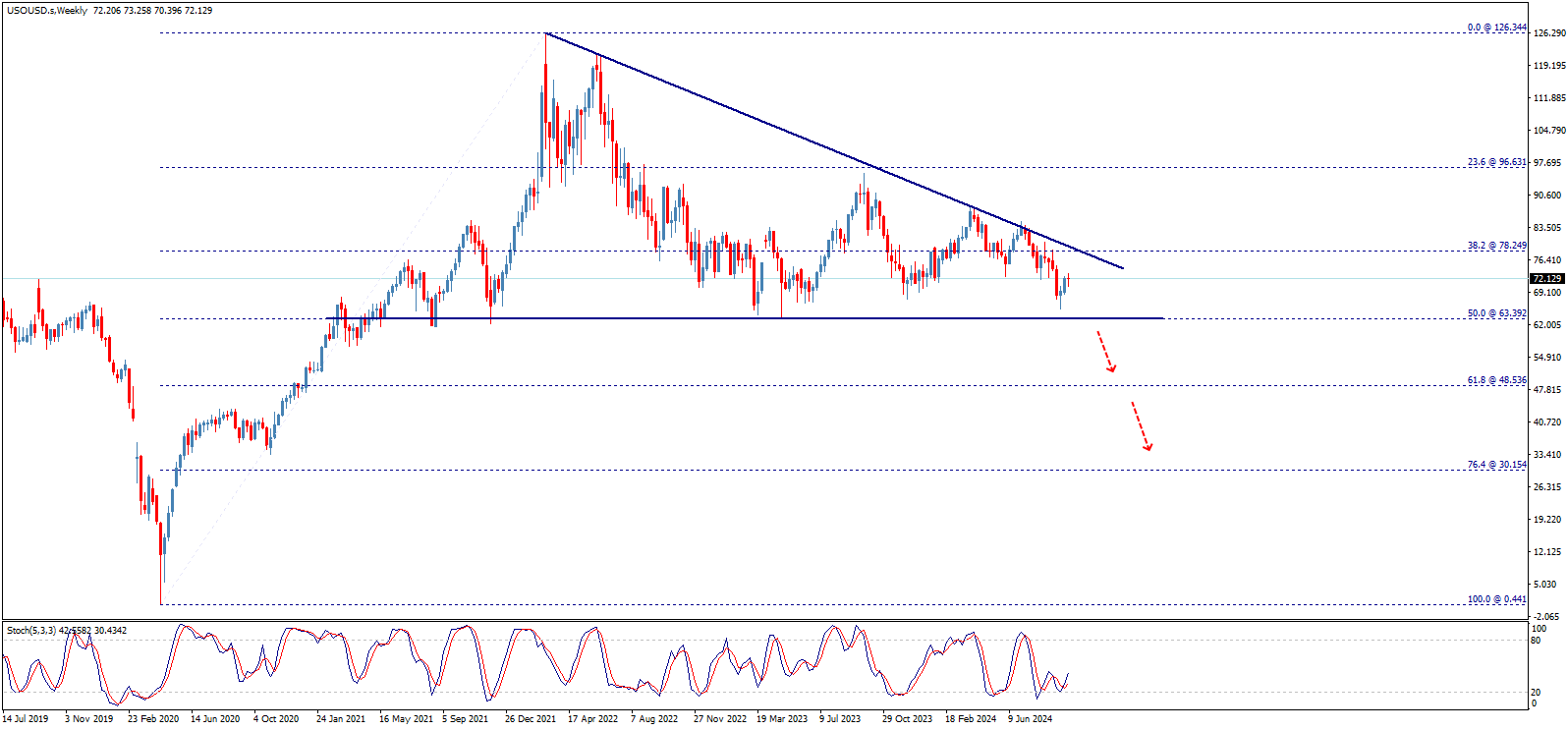
On the other hand, the price has been consolidating inside a descending triangle since the historical peak mentioned earlier. The support level of this pattern lies at $63.40, and a breakdown could push the price lower, testing the 61.8% Fibonacci retracement level near $48.54.
Alternative Perspective
On the daily chart, we observe that the price continues to make lower highs during its downward journey from the previously mentioned peak. After a brief corrective upward move, the price is once again facing bearish pressure, which is likely to continue the downtrend, as indicated by the loss of positive momentum shown clearly by the Stochastic indicator.
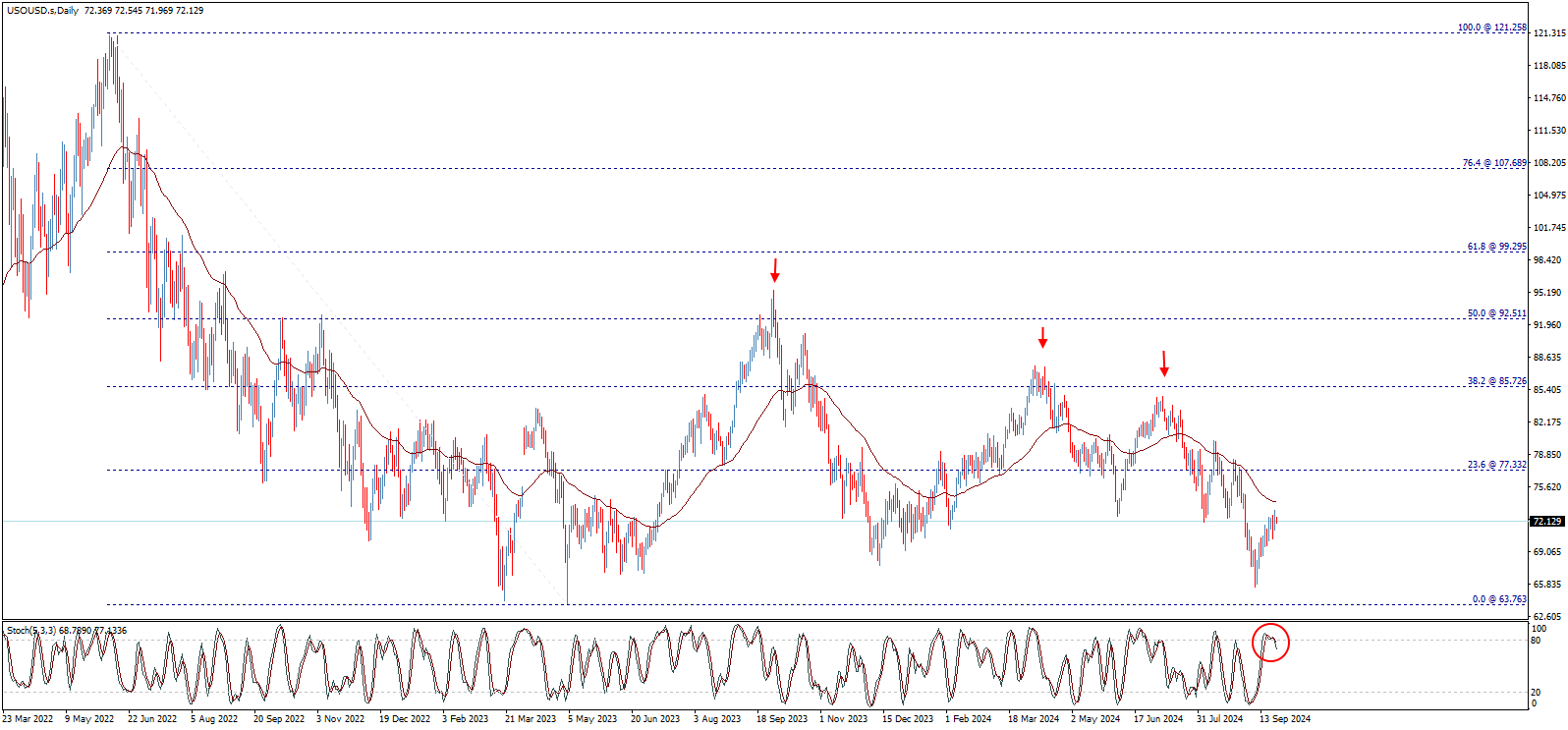
These factors suggest that the price is likely to continue its bearish trend in the near term, targeting $69.60 and $66.00, followed by a critical support level at $63.40. Breaking this support would result in further declines towards the targets mentioned earlier.
Alternative Scenario
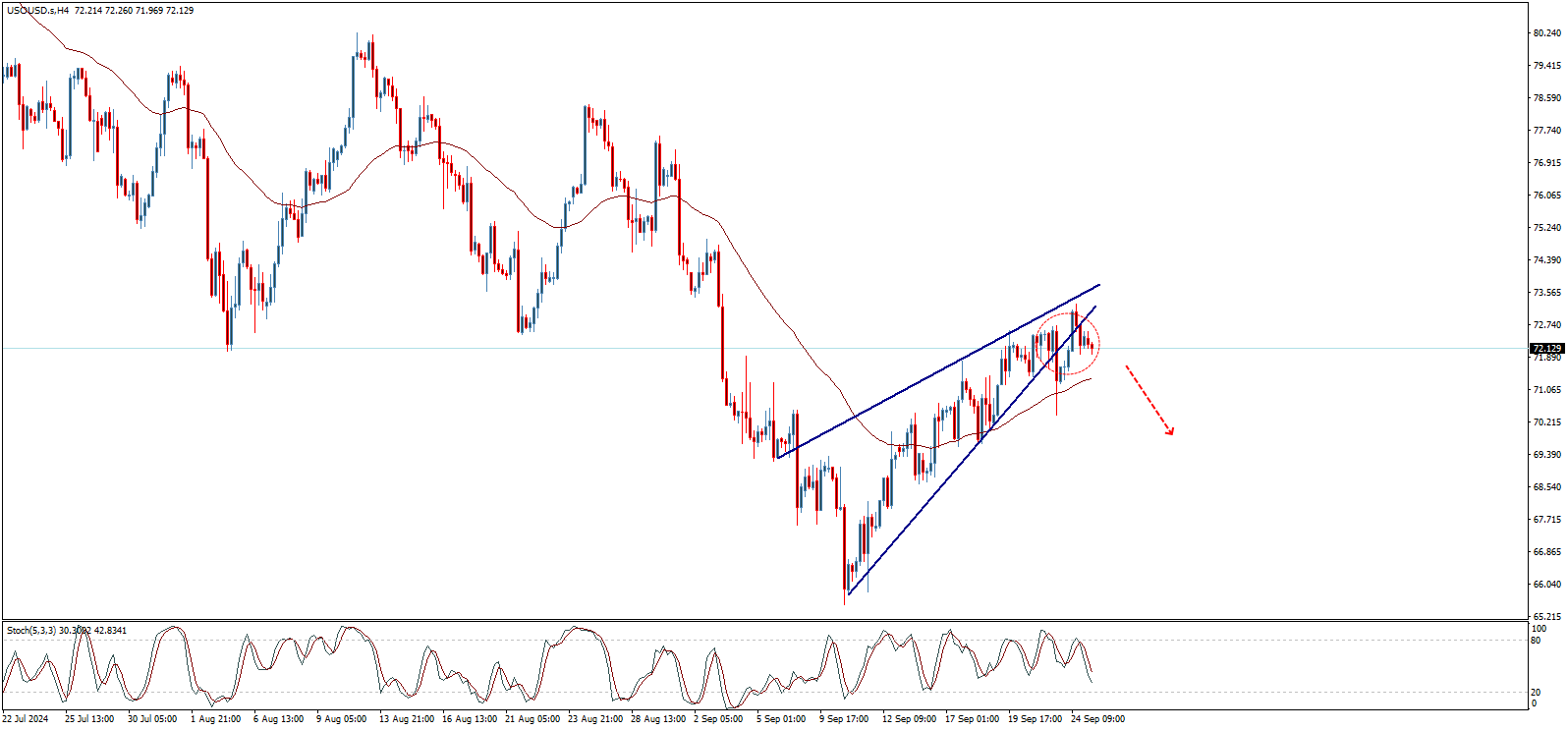
On the other hand, a recovery above the resistance areas around $78.25 would halt the expected bearish trend and push the price toward recovery, initiating new bullish waves targeting $85.00, followed by $96.60.
The EURGBP suffers big losses – Forecast today – 25-9-2024

The EURGBP price was affected by big negative pressures due to the frequent consolidation within the bearish channel, to suffer big losses since crawling below the additional support at 0.8400, noticing reaching 0.8310 level followed by attempting to form some correctional waves due to stochastic attempt to exit the overbought areas.
Note that the fluctuation below the additional barrier at 0.8360 allows us to suggest more negative attempts that might target 0.8280 level soon, noting that surpassing the barrier might postpone the negativity for now to support the chances of resuming the bullish correction and retest 0.8400 before reaching the additional negative target.
The expected trading range for today is between 0.8285 and 0.8360
Trend forecast: Bearish
10 Best Stocks to Benefit from Interest Rate Cuts and Profit in this Bull Market

Lowering Interest Rates and Their Impact on Stocks
It is now clear that we have entered a new era marked by a series of consecutive interest rate cuts by the Federal Reserve, which is almost certain.
For the first time since March 2020, the federal funds rate has been lowered by 0.5%, double what many economists had anticipated. Interestingly, this isn't the end of the story.
The Federal Reserve is expected to continue cutting rates throughout this year and into 2025, with the federal funds rate predicted to drop to 3.4% by the end of next year.
But how might stocks react during such a period?
In theory, lower interest rates should boost stock prices, as lower borrowing costs allow companies to retain more profits from their sales.
Additionally, rate cuts enhance the appeal of stocks compared to bonds, as bond yields decrease when bond prices rise (bond yields move inversely to bond prices).
This article will highlight the best sectors and stocks that might benefit from rate cuts, with the likelihood of further reductions this year and into 2025.
In a low-interest-rate environment, certain stocks and sectors that have underperformed might start to outshine the large-cap tech stocks that have been investor favorites in recent years.
Real Estate and REITs (Real Estate Investment Trusts)
The real estate sector and REITs stand to benefit the most from lower interest rates in two ways: companies often expand by purchasing and developing real estate through loans, while individuals are incentivized to buy homes due to lower mortgage costs.
Some of the best stocks in this area include:
- D.R. Horton, Inc. (DHI)
| Market Cap | PE Ratio | Current Stock Price | Analysts’ Avg. Price Target |
|---|---|---|---|
| $62.53 billion | 12.89 | $191.89 | $214.63 |
- National Storage Affiliates Trust (NSA)
| Market Cap | PE Ratio | Current Stock Price | Analysts’ Avg. Price Target |
|---|---|---|---|
| $3.69 billion | 29.39 | $48.57 | $57.14 |
- Realty Income Corporation (O)
| Market Cap | PE Ratio | Current Stock Price | Analysts’ Avg. Price Target |
|---|---|---|---|
| $53.67 billion | 57.89 | $61.53 | $63.90 |
Consumer Goods and Discretionary Goods Sector
The consumer goods and discretionary goods sectors also benefit from lower interest rates, especially when it comes to big-ticket items like cars and luxury goods.
- General Motors Company (GM)
| Market Cap | PE Ratio | Current Stock Price | Analysts’ Avg. Price Target |
|---|---|---|---|
| $54.94 billion | 5.55 | $48.88 | $54.57 |
- Honda Motor Co., Ltd. (HMC)
| Market Cap | PE Ratio | Current Stock Price | Analysts’ Avg. Price Target |
|---|---|---|---|
| $51.25 billion | 7.24 | $32.72 | $35.00 |
Energy Sector
Lower interest rates can help boost economic growth and raise crude oil prices, making the energy sector one of the best options in this environment.
- Exxon Mobil Corporation (XOM)
| Market Cap | PE Ratio | Current Stock Price | Analysts’ Avg. Price Target |
|---|---|---|---|
| $512.12 billion | 13.80 | $115.27 | $134.00 |
- ConocoPhillips (COP)
| Market Cap | PE Ratio | Current Stock Price | Analysts’ Avg. Price Target |
|---|---|---|---|
| $127.59 billion | 12.22 | $109.87 | $142.60 |
Healthcare Sector
The healthcare sector also benefits from lower interest rates as hospitals and healthcare companies can finance expansion projects and purchase medical equipment at lower costs.
- UnitedHealth Group Incorporated (UNH)
| Market Cap | PE Ratio | Current Stock Price | Analysts’ Avg. Price Target |
|---|---|---|---|
| $530.97 billion | 37.99 | $575.00 | $605.83 |
Best Brokerage Platforms for Stocks Benefiting from Lower Interest Rates
- Pepperstone, best brokerage company for stocks benefiting from lower interest rates. Trusted for beginners. Dubai license. Minimum deposit: 0$. 20% discount on trading.
- XM, best platform for stocks benefiting from lower interest rates. Provides educational material and copy trading. Dubai license. Minimum deposit: 5$. Regular competitions and financial prizes.
- Plus500, best licensed brokerage company for stocks CFDs benefiting from lower interest rates. Dubai license. Minimum deposit: 100$.
Natural gas price gathers its strengths – Forecast today – 25-9-2024

Natural gas price formed some sideways fluctuation after touching 2.690$ level, in order to gather the required additional positive momentum to resume the previously suggested bullish attack.
The main stability above the major support at 2.320$, and 2.520$ level attempt to form the additional support line, these factors support the bullish overview, waiting to record the next target at 2.780$.
The expected trading range for today is between 2.520$ and 2.780$
Trend forecast: Bullish